
How AI content detectors turn text into a score
Understand classifier features, thresholds, confusion matrices, base rates, watermark and provenance evidence, drift, bias and the limits of authorship claims.
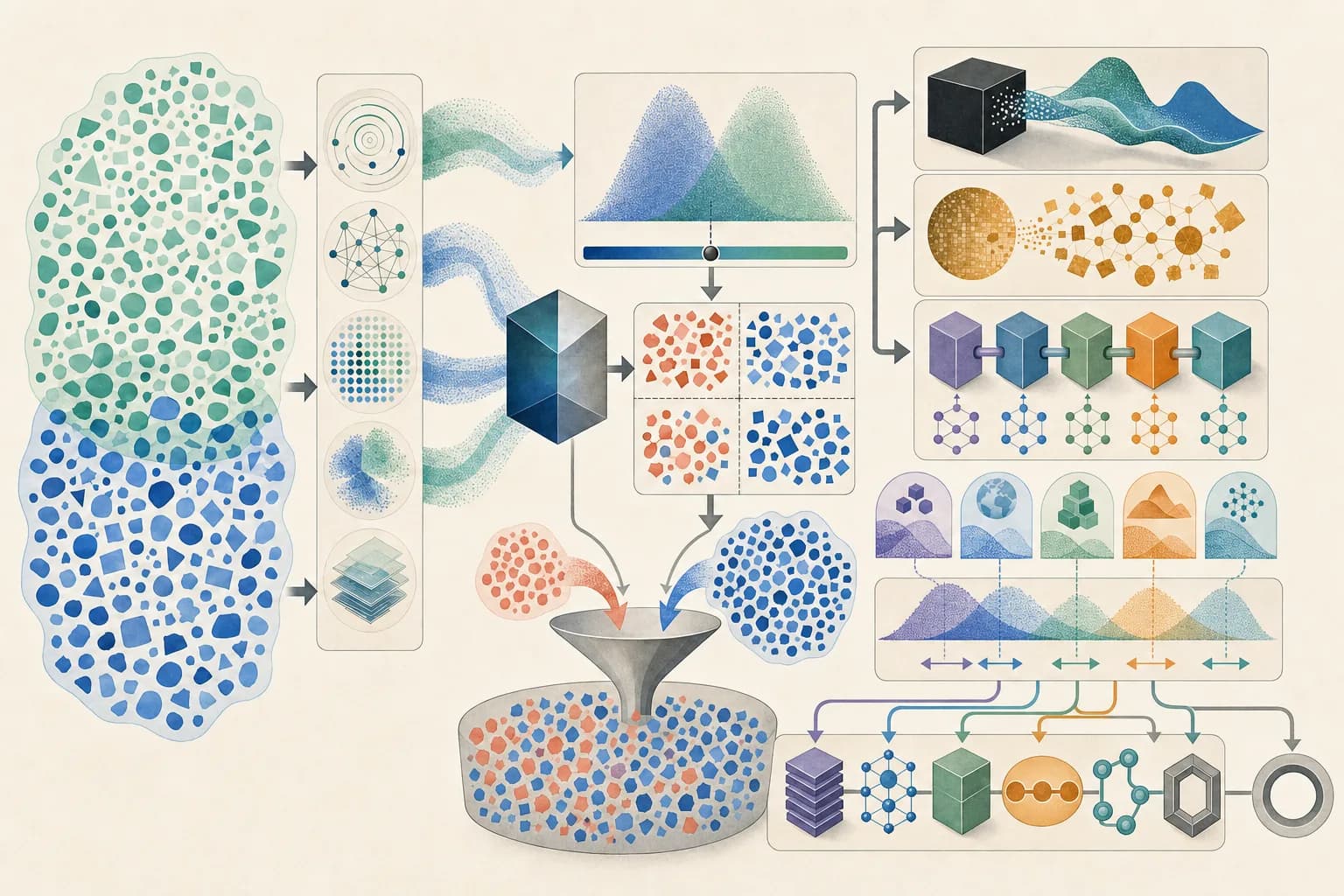
Most AI text detectors are classifiers: they compare patterns in submitted text with patterns learned from selected human and model-generated examples, produce a score, and apply a threshold. Depending on the system, inputs may include token likelihood, variation, syntax, repetition, embeddings and broader document context. The score is conditional on the detector's training data, version, language, text length, domain, generator and editing history; it is not direct observation of who wrote the text or a calibrated probability of misconduct. Generator-specific watermarks, retrieval matches and independent provenance records are different evidence mechanisms. Every route can fail, so decisions need context, validated performance for the actual population and human review rather than a single score.
Define the detector's question and reference population
A system does not detect an abstract property called AI writing. It estimates whether an input resembles examples assigned to classes under a particular data and labeling process. Review which generators, prompts, human sources, languages, genres, lengths and dates appear in the evaluation set, and whether mixed human–AI editing is represented. A model trained to distinguish one generator from one essay collection may not answer a question about another model, language or workplace genre.
- Record the detector and model version used for the report.
- Identify the supported language, length and file conditions.
- Find evaluation data that resembles the real decision population.
- State what label the system predicts and what it does not establish.
Understand features, scores and thresholds
Learned detectors transform text into signals and combine them into a continuous score. Some methods use likelihood-related regularity, local variation or model representations; others train a classifier directly on labeled examples. A threshold converts the score into a category or highlight. Moving that threshold trades false positives against false negatives. Per-sentence highlights may indicate which spans influenced the model, but they do not reveal a writer's process, and a score should not be read as a percentage of words proved to be machine-authored unless the product explicitly defines and validates that interpretation.
Separate classifiers from generator traces and provenance
A statistical classifier can operate without access to the generator. A watermark instead changes or constrains generation so a keyed detector can test for a designed pattern; retrieval can compare text with retained model outputs or logs. Provenance records—draft history, citations, source notes, version control and disclosed tool use—document a process independently of linguistic resemblance. These mechanisms have different coverage, privacy costs and failure modes: edits can weaken a mark, logs can be incomplete, records can be forged, and unmarked or unknown generators sit outside a closed trace system.
Evaluate the confusion matrix, base rate and drift
Measure sensitivity, specificity, false-positive and false-negative rates on representative data, with uncertainty and subgroup results. Then apply the real base rate: even a small false-positive rate can supply many of the flags when genuine positives are uncommon. Re-test after detector, generator, prompt, domain, language or editing practices change; published results from another version are not automatically transferable. Research has demonstrated detector vulnerability to paraphrasing and disproportionate false flags for some non-native English writing samples, so aggregate accuracy alone is inadequate.
Use a flag as a review lead, not a verdict
Preserve the original report and version, disclose the threshold and limitations, and compare the flag with the assignment, drafts, citations, edit history, permitted assistance and the writer's explanation. Give the affected person a meaningful opportunity to respond, and define an appeal path before deployment. Do not demand that writers distort natural language merely to lower a score. Turnitin's current guidance itself says its model can misidentify human, AI-generated and AI-paraphrased text and should not be the sole basis for adverse action. For consequential decisions, validate the complete policy and evidence process—not only the detector.
Check the primary references
Check the source against the result
Original hypothetical MCXAI evaluation — A review population contains 1,000 submissions. The assumed true prevalence for this exercise is 10%: 100 AI-generated and 900 human-written submissions. At one threshold, the hypothetical detector has 80% sensitivity and a 5% false-positive rate on a representative test set.
Expected threshold outcomes — True positives: 80 of 100. False negatives: 20 of 100. False positives: 45 of 900. True negatives: 855 of 900. Total flagged: 125. Of those flags, 80 are true positives and 45 are false positives, so the positive predictive value in this hypothetical population is 80 ÷ 125 = 64%.
A 5% false-positive rate does not mean that only 5% of flags are wrong. Because human-written submissions are much more common in this fixture, they contribute 45 of the 125 flags. The calculation illustrates threshold and base-rate effects only; it is not a benchmark for a real product, and no individual score proves authorship or misconduct. All figures and wording were created for MCXAI.
Review the evidence standard before using a score
MCXAI does not offer an AI-writing detector or authorship verdict. Use the evaluation methodology to separate a model output, a validated performance claim and the process evidence needed for a real decision.
Read the evaluation methodology