
How to make writing clearer without changing its meaning
Map actors, actions, conditions, quantities, exceptions and uncertainty; simplify the structure, expose gaps, and reverse-check every claim against the source.
Clarify structure only after recording the meaning that cannot move: who acts, what they do, the object, conditions, quantities, dates, exceptions, negation, uncertainty and required terminology. Put the reader's decision first, name responsible actors, split nested conditions, place exceptions beside the rule they limit and define specialized terms when the audience needs it. Then map every revised statement back to the source. If the source leaves a boundary or responsibility unclear, expose and assign that gap—do not silently complete it.
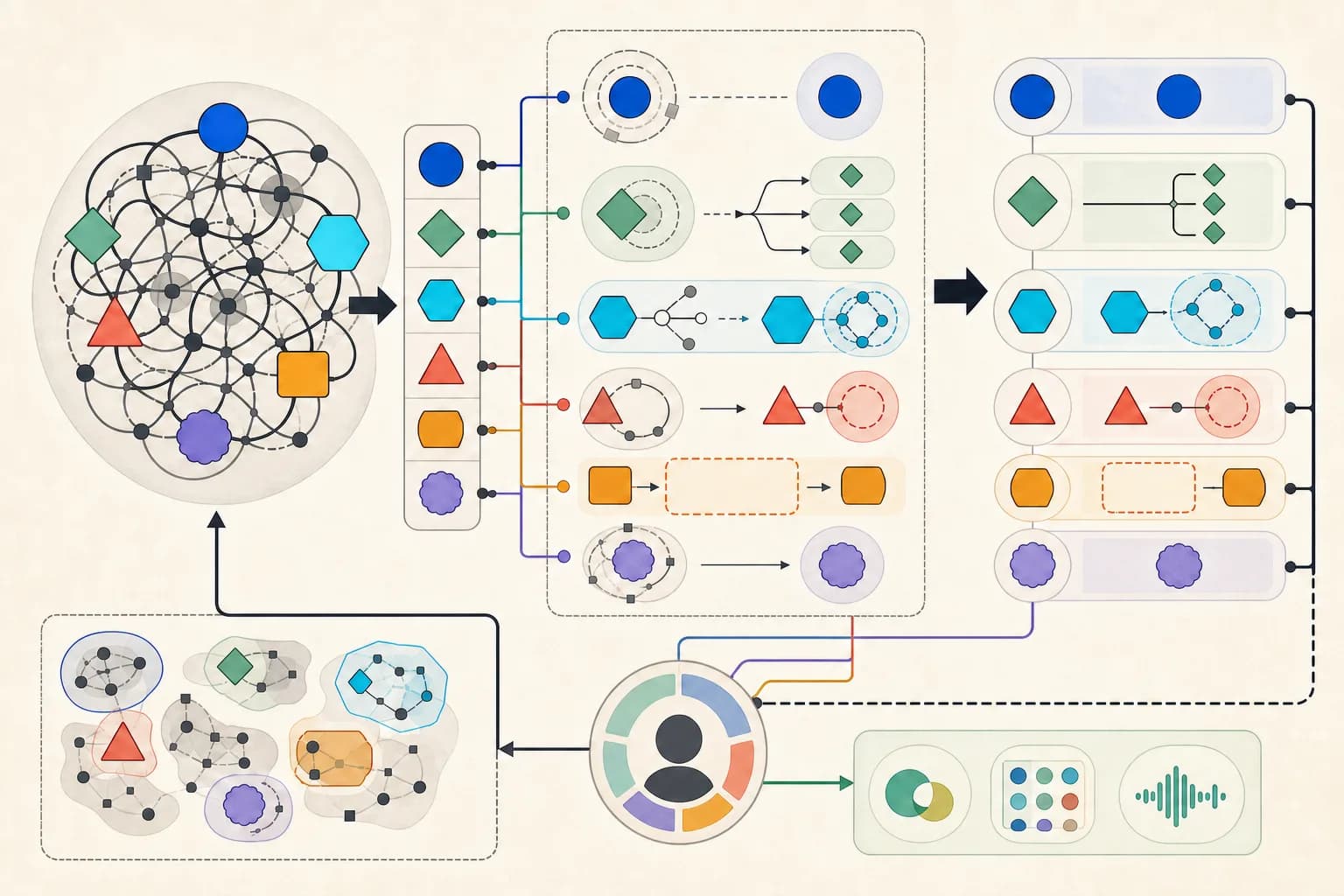
Create a meaning ledger before editing the sentence
List each proposition in the source and tag its actor, action, object, condition, quantity or time, exception, negation, level of certainty and evidence. Preserve defined terms and modal verbs such as must, may and should because they can carry authority or obligation. Mark pronouns with unclear referents, ranges with missing endpoints and terms whose meaning depends on a policy, version or jurisdiction.
- Separate facts, instructions, inferences and recommendations.
- Record every number, date, unit and comparison direction.
- Attach each condition and exception to the rule it changes.
- Mark ambiguity as an open question instead of resolving it by style preference.
Make responsible actors and concrete actions visible
Name the person, team or system when responsibility matters, and move the main action close to that subject. Prefer a direct verb over a distant noun phrase when both express the same fact. Passive voice can still be accurate when the actor is unknown, intentionally withheld or less important than the result; inventing an actor for the sake of active voice changes meaning.
Order conditions and exceptions around the reader's decision
Split a sentence when it contains multiple decisions, then put prerequisites before the action and consequences after it. Place an exception immediately beside the rule it limits, and use a list only when the items share the same grammatical job. Preserve logical operators: all is not any, before is not by, and unless cannot be replaced with if without checking the resulting truth conditions.
Use familiar language without removing necessary precision
Replace inflated or vague wording with the specific word the intended reader uses, but retain technical terms that distinguish real concepts. Define an unusual term at first use or link to an authoritative definition; expand an abbreviation when the audience may not know it. Shorter words and sentences can reduce decoding effort, yet a readability score cannot tell whether an instruction is factually complete or safe.
Reverse-check the revision and test the unresolved edges
For every revised sentence, point to its exact support in the source ledger. Compare actors, actions, quantities, chronology, negation, uncertainty and scope in both directions: the revision must add nothing and omit nothing material to its purpose. Ask a subject owner to decide exposed policy gaps, then test the revision with representative readers and assistive technology. Record the reviewed source version so a later update does not leave the clear copy confidently out of date.
Check the primary references
Check the source against the result
Original MCXAI policy fixture: With the exception of incident reports, with respect to which review is undertaken continuously by on-call personnel, requests received subsequent to 16:00 UTC will be queued for review on the business day following receipt, while those received prior to that time are reviewed on the same business day.
On-call staff review incident reports at any time. They review routine requests received before 16:00 UTC on the same business day and queue requests received after 16:00 UTC for the next business day. The original rule does not say what happens at exactly 16:00 UTC.
The revision makes the actor, exception, two time conditions and two outcomes visible without changing before to by or after to at. Rather than inventing an inclusive boundary, it exposes the missing exactly-16:00 rule for the policy owner to resolve. The fixture and revision were written for MCXAI and do not reproduce external prose.
Trace source sentences before you edit them
The Text Summarizer can select source-order sentences and show their origin locally. Use that trace as an anchor; the tool does not rewrite prose or certify that a revision preserves meaning.
Open Text Summarizer