
How to create a study guide for active practice
Map assessment objectives to verified course evidence, build retrieval and application prompts, correct errors and schedule later attempts.
An effective study guide is a practice system, not a shorter copy of the notes. Start with the actual assessment objectives, format, permitted resources and approved course sources. Map each objective to evidence and the kind of performance it requires, then write prompts that make you recall, explain, compare, calculate or apply before revealing an answer. Check every attempt against the source, record errors and unsupported reasoning, and schedule later mixed attempts. Do not invent topic weights, treat familiarity as mastery or assume one successful response proves durable learning.
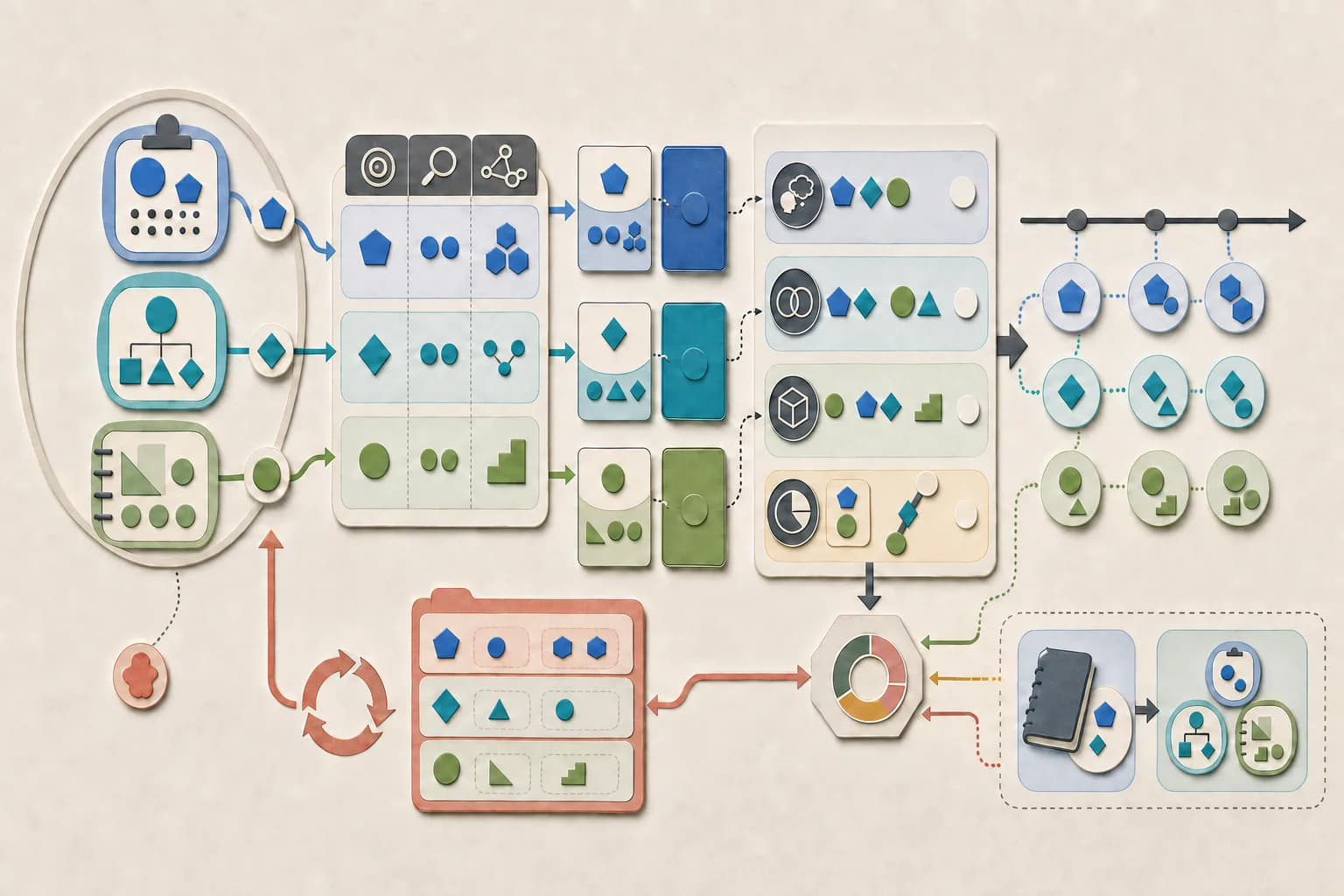
Lock the assessment boundary before collecting content
Record the assessment date, objectives, format, permitted resources, instructor directions and any published weighting. Build a source ledger from the current syllabus, assignment brief, lecture material, readings, worked examples and instructor corrections. Mark versions and unresolved conflicts. Exclude guesses from classmates, remembered emphasis and generated explanations until an accountable source verifies them. Page count, repetition and apparent difficulty do not prove that a topic has more assessment weight.
- Copy each stated objective and instruction without broadening it.
- List the approved source and version supporting each objective.
- Record the required performance: recall, explain, compare, calculate, apply or evaluate.
- Mark missing weights, ambiguous scope and source conflicts as questions for the instructor.
Build an objective-to-evidence-and-question matrix
Give every objective a row containing the minimum evidence, a representative example, a likely misconception, the required question form and a source pointer. Split compound objectives when they require different decisions, but retain the relationship between them. A definition objective needs more than a copied definition if the assessment asks for comparison or application. Conversely, do not add attractive background material that the approved scope does not support.
Turn the matrix into prompt-first study entries
Put the question, cue or incomplete problem before the answer so the guide can test memory instead of displaying it continuously. Use a compact answer containing the decisive claim, reasoning or steps, material condition and source location. Add contrasts and examples only when they test the objective. Write plausible error prompts for distinctions learners commonly collapse, but do not present an invented misconception as something the course actually teaches.
Attempt closed-resource, check immediately and vary the task
Answer from memory or solve the problem before opening the source, then compare every material step with the approved answer and correct both errors and low-confidence guesses. Mix recall with explanation, comparison, calculation and transfer questions that match the assessment rather than producing a deck of recognition-only cards. Retrieval research supports active recall, but question form and feedback matter; an answer recalled fluently in one wording may still fail when the task changes.
Schedule later attempts from observed performance
Place several study sessions before the assessment and revisit content after a delay instead of completing one long pass. Bring missed, incomplete or unsupported answers back sooner, while still checking successful items later in a mixed set. Record the date, prompt form, whether resources were used, accuracy and correction. Use performance records to allocate time, not confidence alone. No fixed interval works for every subject, learner or retention goal, so preserve time for sleep, instructor questions and a final representative practice check.
Check the primary references
Check the source against the result
Original fictional MCXAI assessment fixture — Harbor Ecology 204 has a closed-note quiz on 29 July. The brief names three objectives: distinguish primary from secondary succession by starting conditions; use the supplied closed-population estimator N = (M × C) ÷ R and report a whole fish; and judge whether an observational marsh result supports causation. Approved course notes state that a new volcanic island begins with bare rock and no soil, while a storm-cleared meadow retains soil. In the practice survey, 48 fish were marked, 60 were caught later and 12 in the second catch were marked. At six marsh sites, greater freshwater inflow occurred with lower salinity and higher seedling counts; sites were not randomly assigned and no intervention was made. The instructor provides no objective weights.
Study-guide entries — Objective 1 prompt: Which succession type fits each site, and what starting-condition evidence decides? Answer: volcanic island = primary because no soil is present; meadow = secondary because soil remains. Objective 2 prompt: Estimate the population before checking the supplied formula. Answer: (48 × 60) ÷ 12 = 240 fish under the estimator. Objective 3 prompt: Does the marsh observation establish causation? Answer: no; it records an association across six non-randomized sites and does not isolate freshwater inflow as the cause. Practice plan: attempt all three prompts closed-note on 20 July and check against the approved notes; retry missed or partly supported prompts on 22 July; attempt one new comparison, calculation and evidence-judgment question on 25 July; then run a mixed closed-note check on 28 July. The guide marks objective weighting unknown rather than guessing.
The succession answers rest only on the stated starting conditions, and 240 is the direct result of 48 × 60 ÷ 12. The calculation does not verify that a real population is closed or that the estimator's other assumptions hold. The marsh evidence supports an association, not a causal conclusion. The dates are one fictional schedule rather than a universal spacing prescription; one correct attempt or high confidence is not labelled mastery. The course, assessment, notes and practice data are original fictional MCXAI material and do not reproduce third-party course content.
Map relationships inside one study objective
The local Concept Map Generator can arrange relationships you supply. It does not select exam content, create authoritative answers, score mastery or replace closed-resource retrieval practice.
Open Concept Map Generator