
How to generate practice questions from real learning goals
Blueprint source-backed retrieval, explanation, calculation and transfer questions; verify every key, audit accessibility and revise from pilot evidence.
Start with the exact source and a blueprint that pairs each learning objective with the knowledge or reasoning a learner must retrieve. Draft fewer questions than the requested count if the source cannot support more distinct targets. Mix direct retrieval with explanation, calculation, comparison and transfer only where those tasks match the objective. Write and independently solve the answer key or scoring rubric before approving each prompt, trace every required fact to the source, and remove cues that reveal the answer. Then audit ambiguity, accessibility, irrelevant cultural or language load, duplicate coverage and difficulty; pilot the set and revise from observed responses. A generated item is a draft, a quiz score is evidence about performance under those conditions, and neither automatically proves item validity or broad mastery.
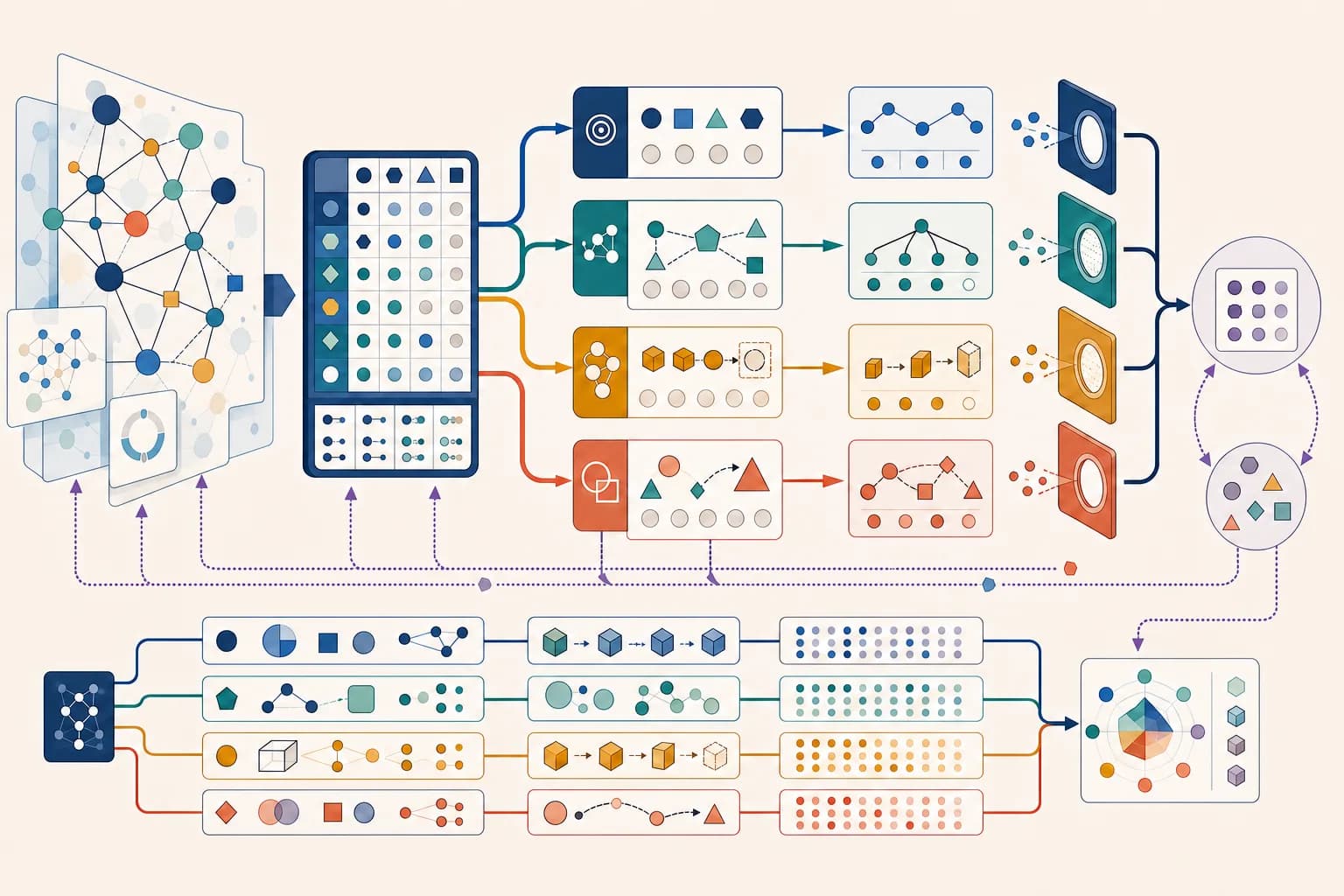
Build a source-and-objective blueprint before writing prompts
Confirm the source version, permitted scope and intended learner task. List the claims, relationships, procedures, examples, numbers, qualifiers and unresolved gaps that the material actually contains. For each learning objective, specify what a successful response must retrieve, explain, calculate, distinguish or apply, then allocate questions across that blueprint. Do not inflate the set with paraphrased duplicates merely to reach a requested quantity, and do not ask for facts or conclusions absent from the source. Keep a source locator beside every planned answer so later edits remain auditable.
- Name the intended learner and later task.
- Write each observable learning objective.
- Map the source evidence and limits for that objective.
- Choose the response process before choosing the item format.
- Mark uncovered and overrepresented objectives.
Use question forms that require the intended thinking
Use a short-answer or completion prompt when the objective is unaided retrieval, but remove wording, grammar and nearby material that supplies the answer. Ask an explanatory question when the learner must connect causes, mechanisms, evidence or principles. Use calculations only when the source defines the quantities, units and comparison baseline. Use contrasts and scenarios to test discrimination or transfer without adding hidden domain knowledge. Selected-response, constructed-response and interactive formats are delivery choices rather than levels of rigor: the prompt must still elicit the intended knowledge instead of reading skill, test-taking tricks or recognition of the longest option.
Write the key or rubric first and solve it independently
Answer each draft without relying on the author's intended interpretation, then compare the result with the source. A single-best-answer item needs one defensible answer and distractors that are clearly wrong for relevant reasons, not through absurdity, grammar mismatches or invented facts. A constructed response needs required elements, acceptable alternatives, partial-credit rules and examples of boundaries; do not demand one phrase when several explanations are valid. Recalculate every value with units and an explicit baseline, verify dates and terminology, and have a second reviewer solve the item from a clean copy. Revise the prompt when knowledgeable reviewers disagree rather than hiding ambiguity in the scoring key.
Audit construct, fairness and accessibility together
Remove background knowledge, cultural assumptions, decorative detail and reading complexity that are not part of the learning objective. Check names, contexts and distractors for stereotypes or avoidable sensitivity, while recognizing that editorial review alone cannot establish statistical fairness. Present instructions before the response control, label and group controls programmatically, preserve logical reading order and keyboard operation, expose status and error feedback to assistive technology, and provide text equivalents for essential visual information. Do not encode the answer only with color, require speed unless timing is part of the construct, or call an accommodation an unfair hint.
Pilot, diagnose and revise before interpreting scores
Try the set with representative learners under the intended conditions and record where they misread the task, select an unintended correct answer, encounter inaccessible interaction or spend time on irrelevant complexity. Review objective coverage, completion time, omitted responses, option behavior and the reasoning shown in constructed answers. A very easy or difficult item is not automatically defective; compare its behavior with its intended role and source. Revise and pilot again rather than changing the key after delivery. For learning, return accurate feedback and revisit important ideas after a delay. For consequential grading or selection, use appropriately validated assessment processes and trained review instead of treating a small generated practice set as a measurement instrument.
Check the primary references
Check the source against the result
Original fictional MCXAI note set — During a four-week maintenance pilot, 24 calibration stations were observed. Twelve displayed machine state with a color-only light; twelve displayed the same light plus a written state label. Stations entered the two groups according to availability rather than random assignment. All observations came from the morning shift. Median reset time was 9 minutes for the color-only group and 6 minutes for the written-label group. The pilot recorded reset time, not reset errors, user preference or accessibility outcomes.
Blueprint — Objective A: retrieve the two recorded medians. Objective B: calculate an absolute and relative comparison with a stated baseline. Objective C: distinguish the observed association from causation and wider generalization. Objective D: design a stronger follow-up. Question 1, retrieval — What median reset time was recorded for each group? Key: color-only, 9 minutes; written label, 6 minutes. Question 2, calculation — Using the color-only median as the baseline, state the absolute difference and relative reduction in median reset time. Key: 9 − 6 = 3 minutes; 3 ÷ 9 = one third, or approximately 33.3%. Question 3, supported conclusion — Which conclusion is supported? A. Written labels caused a three-minute improvement at every station. B. In this pilot, the written-label group had a three-minute lower median reset time than the color-only group. C. Written labels reduced reset errors by one third. D. The result applies equally to every work shift. Key: B. A claims causation and every-station performance, C invents an unmeasured outcome, and D generalizes beyond the morning shift. Question 4, transfer — Design a follow-up that could test whether adding written labels causes shorter reset times across shifts. Rubric: the response must manipulate label presence, randomly assign or counterbalance the interface condition, include more than the morning shift, hold the reset procedure sufficiently stable, predefine reset time as an outcome and report uncertainty; error and accessibility outcomes require their own direct measures.
The four questions map to distinct objectives and every keyed fact comes from the fictional note set. The arithmetic was independently checked: 12 + 12 = 24, 9 − 6 = 3 and 3 ÷ 9 = 0.333…, so the stated 33.3% is relative to the explicit 9-minute baseline. The supported-conclusion item retains the nonrandom assignment, morning-shift scope and measured outcome, and it does not claim that labels caused the difference or reduced errors. The open design question uses a rubric because more than one sound study design is possible. The fixture and questions are original MCXAI material and do not reproduce a published item bank.
Map the source before drafting the item set
The browser-local Concept Map Generator can organize concepts and evidence relationships from a structured brief. It does not generate questions, validate answer keys or measure learning.
Open Concept Map Generator