
How to turn a lecture into revision notes you can test
Capture a lecture's structure, reconstruct it from memory, reconcile every claim with authorized sources and build traceable retrieval prompts.
During the lecture, capture its structure rather than every sentence: objectives, claims, definitions, evidence, worked examples, qualifiers and open questions, each with a slide, sequence or recording anchor when one is authorized. Soon after class, close the sources and reconstruct the main ideas from memory. Then compare that reconstruction with the lecture materials, label what the lecturer stated separately from your inference, correct omissions and keep unresolved conflicts visible. Turn the reconciled material into question-first revision units and test them again after a delay. Revision notes are a learner-built study aid, not a transcript, an official course record or proof that the material has been mastered.
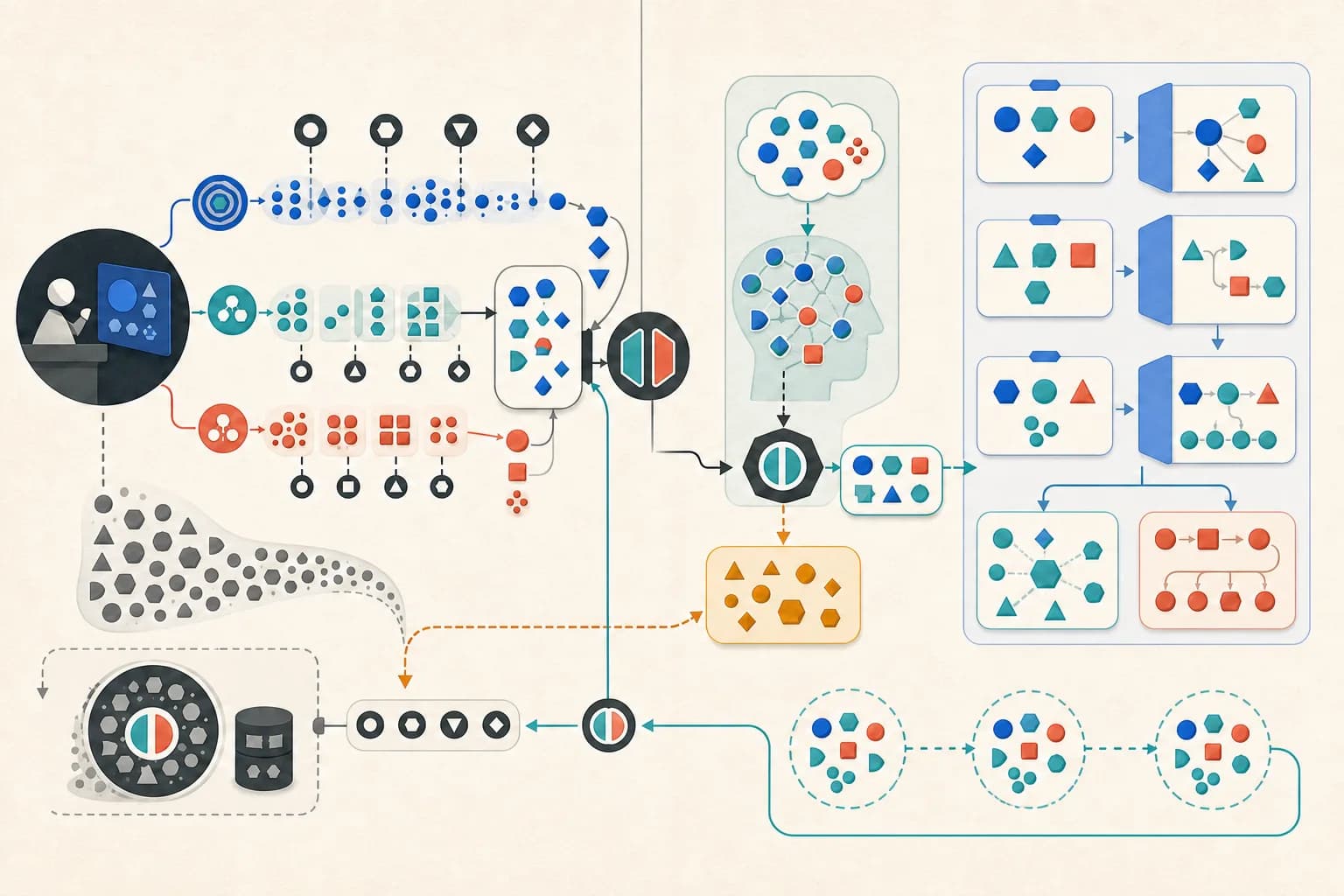
Capture the lecture's structure and trace anchors
Start with the course, date, lecture topic and stated objectives. During the session, capture the main claim in each segment, the evidence or reasoning offered, necessary definitions, worked examples, conditions that limit the claim and questions the lecturer leaves open. Add a slide number, chapter marker, sequence cue or timestamp only when the material and recording are authorized. Use compressed phrases and diagrams you can later expand, and mark anything you did not hear or understand instead of filling the gap from intuition.
- Separate claims, evidence, examples, instructions and qualifications.
- Attach each important number, definition or diagram to its source anchor.
- Mark lecturer emphasis as observed emphasis, not automatic assessment weighting.
- Record uncertainty with a question rather than a confident completion.
Reconstruct the main ideas before reopening the source
As soon as practical after the lecture, close the slides, recording and raw notes. On a blank page, restate the objectives, explain each central relationship, rebuild the worked process and list the limits you remember. This creates a retrieval attempt and makes gaps visible. A missing point may reflect ordinary forgetting, divided attention or weak capture; it does not prove that the point is unimportant. Keep the reconstruction visually distinct so remembered wording cannot later be mistaken for a lecturer quotation.
Reconcile memory with authorized lecture evidence
Reopen the raw notes and any permitted slides, captions, readings or recording. Compare each reconstructed statement in both directions: find its source support, then check whether the source contains a condition, example or contradiction the reconstruction omitted. Maintain three explicit states—stated or displayed by the lecturer, inferred by the learner, and unresolved question. Correct caption and transcription errors against the audio and visual context where access is allowed. If two authorized sources conflict, retain both versions and ask the instructor rather than silently choosing the smoother one.
Build compact, question-first revision units
Organize the reconciled material by learning objective, not merely lecture order. Give each unit a retrieval question, a concise answer, the reasoning or worked step, a representative example, the material qualifier and a source anchor. Use a diagram beside words when the relationship benefits from both, but keep essential meaning available without the image. One experiment found benefits from incomplete outline notes for free recall and inference in its specific lecture design; it does not establish one layout as best for every subject. A later direct replication also did not support a general immediate-learning advantage for handwriting over typing, so choose an accessible medium that supports attention, reconstruction and accurate review.
Retrieve, correct and revisit without oversharing
Cover the answer and explain, calculate, compare or apply from the question alone. Check immediately against the reconciled unit, record omitted evidence and unsupported additions, then retry changed prompts after a delay. Mix factual, relational and application questions so recognition of the page layout cannot substitute for understanding. Preserve the course version and review date. Follow instructor, institution, platform, consent, privacy and copyright rules before recording, transcribing, uploading or sharing lecture material; a personal revision note does not create permission to distribute the lecture or its recording.
Check the primary references
Check the source against the result
Original fictional MCXAI lecture record — Metro Methods 112, Ridge Transit pilot. At 04:10, Dr. Sen says the pilot changed boarding order on four routes. At 08:35, a slide reports 64 observed outbound weekday-morning journeys across two dry weeks: 32 before the change and 32 after it. Median departure delay was 7 minutes before and 5 minutes after. At 12:20, Dr. Sen says this is a descriptive before-and-after comparison, not a randomized trial; passenger volume and traffic conditions were not held constant. At 19:05, the board shows 7 - 5 = 2 minutes. At 24:30, the stated objective asks students to calculate the difference, describe the observed result and evaluate what the design supports. The lecture does not report statistical uncertainty or claim an effect across all transit services.
Trace-linked revision unit — Calculate: the observed median departure delay was 2 minutes lower after the change because 7 - 5 = 2 minutes; this is a difference between reported medians, not total rider-minutes saved. Describe: the median changed from 7 to 5 minutes in the sampled outbound weekday-morning journeys. Evaluate: the before-and-after observation is consistent with an association, but it does not establish that boarding order caused the change because the study was not randomized and passenger volume and traffic were not controlled. Scope: four routes, 64 observed journeys, 32 before and 32 after, across two dry weeks. Retrieval prompts: reconstruct the scope; calculate the median difference; name two uncontrolled factors; explain why the causal claim is unsupported. Open question: were comparable routes and journey times paired before and after? The lecture record does not say.
The 2-minute result is direct arithmetic from the fictional 7-minute and 5-minute medians. The revision unit does not add a percentage change, total time saving, significance result, matched-pair design, weekend evidence or wet-weather evidence. It separates the observed association from causation and keeps the missing pairing detail open. Metro Methods 112, Ridge Transit, the lecturer, timestamps, data and notes are original fictional MCXAI material and are not a transcript of a real lecture.
Map one verified relationship from your notes
The local Concept Map Generator can arrange concepts and relationships you supply. It does not transcribe the lecture, decide what the lecturer meant, verify course facts or measure mastery.
Open Concept Map Generator